Page 1 of 1
Head Temperature
Posted: Wed Jun 13, 2007 6:56 pm
by L0084MC
Hay guys, what is the average temperature range on the heads? I let my buggy idle for about 20 minutes with the climate temp at about 82 F and the head temperature settled on about 190 F. Also for the people in the know. what is the best way to test a generator for voltage output.
Posted: Wed Jun 13, 2007 8:36 pm
by Lee
"...what is the average temperature range on the heads?" It depends on where you mounted the sender. I install mine under the #3 spark plug, so the following values are based on that. Head temps between 200 and 300 degrees F are common for city driving or cruising around in first through third gears. Nothing seems to heat things up like freeway driving, so I see head temps between 350 and 400 when freeway cruising for a long period of time. I have read that 400 is right on the edge of safety, and that 425 is where you could experience issues with the valve seats if you run it that hot for too long. With that being said, we also need to question the accuracy of the CHT gauge. The sender is actually a thermocouple, similar to the one that keeps the solenoid open on pilot lights. It generates a small amount of electricity when heated, and the gauge goes up with the voltage increase. The sender is also calibrated for an ambient air temp of 70 degrees F. The temperature reading on your gauge is actually the DIFFERENCE between the ring terminal at one end and the connector at the other end. On a 70 degree day, the gauge should read the correct temperature. When it's hotter outside, the gauge will read lower. When it's colder outside, the gauge will read higher. It's not off by a lot (maybe 30 degrees at temperature extremes), but it's enough to notice. CHT senders used on aircraft are typically 4 feet long (!) so that the connector ends are inside the cockpit, which is usually kept at a comfortable temperature. The gauge reads more accurately (the aircraft senders and gauges also come with an aircraft price tag). Best thing to do is to get ahold of one of those IR thermometers that you can point at something to see what its temperature is. Warm the engine up and point it at the area of the head near your sender. Then you will know how far off the gauge is. After driving the car for a while, you will get an idea of its normal temperature range. If you suddenly see a reading outside that range, you know something's up. "...what is the best way to test a generator for voltage output." Check it with a volt meter. Overly simple? Ok, here's what you do (12 Volt generator assumed): Put the volt meter (not a voltage gauge, but a real electronics meter - digital meters are best for this) on the battery. You should see about 12VDC. Now start the engine. The voltage should increase to around 13VDC. Increasing engine RPMs should result in an increase in voltage, but it should not exceed 14-15VDC. Now turn on your headlights, hazards, windshield wipers, reverse lights, stereo, etc. This will put the maximum load on the generator. Is your battery voltage still higher than your initial (before the engine was started) reading? If so, then your generator is up to the task. If not, it is either tired or you need to lose those 15" subwoofers. Or install an alternator (along with all the goodies that go along with it).
Posted: Thu Jun 14, 2007 12:47 am
by L0084MC
Well, Here's how it adds down Lee. It don't add up, It adds down. battery in car, ignition off ===========12.46 volts. battery in car, at idle, car running===== 12.19 volts. car running, at idle, lights on========= 12.07 volts. car running, lights on, rev engine to about 1800 rpm========12.03 volts. Both regulator and generator are new from the box. How do you Know which one it is, regulator or generator. all these readings were taken at the battery. Can you replace the generator with a alternator.
Posted: Thu Jun 14, 2007 3:58 am
by fubar
Don't forget that new parts are not always good when you diagnose. I got so discouraged with carquest alternators on the pinto buggy , they would actually fall apart, I get the Ford OEM ones from the junk yard. Same with the regulators. The aftermarket ones last about a day in the sand. Try putting the old regulator back on?
Posted: Thu Jun 14, 2007 4:45 pm
by Lee
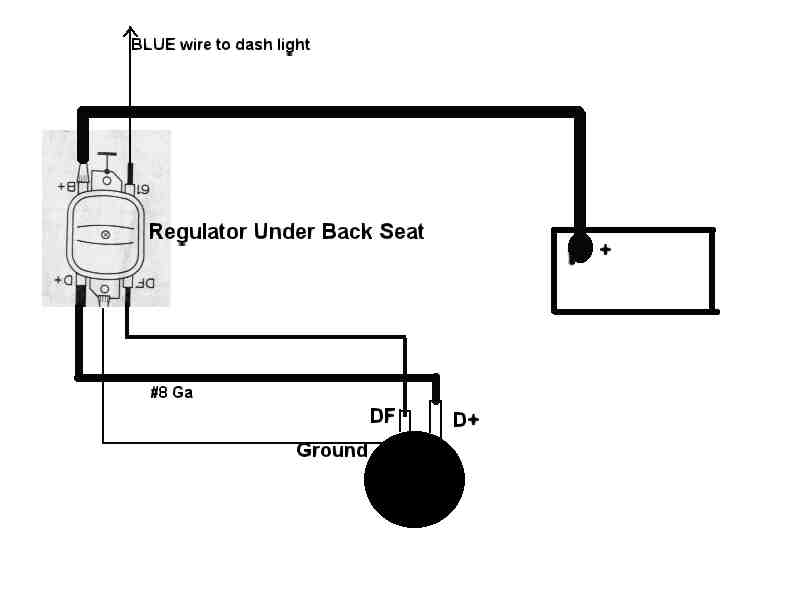
Ok, you have determined that the generator is definitely not charging. Is the warning light hooked up and does it come on? In the conditions you described, the warning light should be on all the time. Double check all your wiring. Here's a chart:
http://www.nls.net/mp/volks/pics/gen.jpg Did you polarize the generator? Here's a website that will help you polarize the generator and do further troubleshooting if needed. Be sure to follow the instructions very carefully, as it's easy to damage components if the wires are placed incorrectly.
http://www.nls.net/mp/volks/htm/gen.htm You can replace the generator with an alternator, but you must pay attention to several details: The alternator uses a different stand than the generator. The alternator will probably need a different belt than the generator. You need an 'alternator style' fuel pump AND THE PROPER PUSHROD for it. If you are running the stock carb, you must make sure the accelerator pump linkage is the later one or it will hit the body of the alternator. One way around this is to add a spacer between the manifold and the carb. You will have to change your wiring around a little, since you will want to use an alternator with an internal regulator. Here's how you do that:
http://www.nls.net/mp/volks/schem/gen_alt.htm Let us know how this turns out!
Posted: Fri Jun 15, 2007 3:39 am
by L0084MC
Thanks Lee, Thats exactly what I need. I will use these instructions tomorrow to test the system. Then I will Know what to do. If the generator is good, I will leave it on the buggy. But if I have to replace everthing, I would just as soon go with a alternator. I will let you know the outcome of the test.
Posted: Fri Jun 15, 2007 2:23 pm
by L0084MC
Here is the update for you Lee. When I first tested the generator, DF to ground and D+ to volt meter, There was nothing. After I polarized the generator I got these readings on a repeat test. At idle =====15.7 volts. At 2000 rpm's =====27.3 volts At 3000 rpm's =====40.1 volts At the battery on idle 12.21 volts with no increase in voltage with an increase in rpm's. Am I to assume that the regulator is bad.
Posted: Fri Jun 15, 2007 4:11 pm
by Lee
"Am I to assume that the regulator is bad." That would be my guess. It sounds like the generator is good, meaning the problem lies either with the regulator or the wiring. Double check all the wires, and if they are in good shape and connected properly, replace the regulator.
Posted: Fri Jun 15, 2007 11:46 pm
by L0084MC
I checked all of the wiring and connections and everything looked good. Put on a new regulator and WHAAA_LA. I'm getting charged. 12.81 volts at idle and 13.93 volts at 2000 rpm's. Thank you Lee. I have never owned a VW product in my life, So it's all new to me. You were right on the money. NOW you are the man. I could not have done it without your guidance.
Posted: Sat Jun 16, 2007 12:12 am
by Lee
WooHoo!!! Good work! You ARE the one who did the work, all I had to do was point you in the right direction. Congrats on getting her charging. The numbers sound perfect.